The Sweetest Legacy
Cadbury mastered organic storytelling over thirty years, turning a simple ritual into a 4 crore brand empire through emotional connection
3 min read

30 years campaign lifespan
22% sales CAGR 2005–08
2× business doubled in 3 years
30% market share today
Cadbury didn't sell chocolate to India. It taught India that chocolate was already theirs — it had just been waiting for them to claim it.
We're going to be upfront with you: we didn't make this campaign. We weren't in the room when Piyush Pandey wrote the jingle for "Real Taste of Life" on the back of a boarding pass. We weren't there when the brief landed at Ogilvy and the entire agency went into a quiet panic about how to sell chocolate to a country with a millennium-old love affair with mithai.
What we did was spend a very long time studying what they built — and more importantly, why it worked when so many louder, more expensive campaigns didn't. Because the Cadbury "Kuch Meetha Ho Jaye" campaign is not a story about a chocolate brand. It's a masterclass in the single most underused strategic tool in Indian marketing: cultural insertion instead of cultural disruption.
Pull up a chair. This is going to be worth your time.
01 — The Problem: A Foreign Bar in a Country That Already Had Sweets
By the early 1990s, Cadbury Dairy Milk had been in India for over four decades — and it was going nowhere. Not because the product was bad. Because the product was miscast. In the minds of most Indian consumers, chocolate was for children. Adults ate mithai. Adults distributed laddoos at weddings, barfi at Diwali, gulab jamun at functions. Chocolate was a foreign, slightly indulgent thing you gave a child as a reward for surviving their maths exam.
The result was a brand in stagnation. Dairy Milk had a loyal but narrow base, sales were plateauing, and every attempt to nudge adults toward chocolate had felt — to use the technical marketing term — awkward. There were tentative 1980s ads of fathers sneaking chocolate while telling their kids bedtime stories. Furtive chocolate. Guilty chocolate. This was not a good brand emotion to be sitting with.
The Strategic Diagnosis Behind the Cadbury Brand Turnaround
Cadbury wasn't losing to a competitor. It was losing to a cultural category. Mithai wasn't just food — it was ritual, identity, and relationship currency accumulated over centuries. You can't outspend a century. You can't outshout a tradition. You can only find the door it left unlocked — and walk in quietly.
The research team, working with Ogilvy India, conducted ethnographic studies of sweet consumption behaviour across India. What they found was the strategic unlock that would change everything: the reason Indians ate sweets wasn't primarily taste. It was a shared emotional occasion. Sweets marked moments — victories, beginnings, reunions, celebrations. The emotion was the product. The mithai was just the vehicle.
And a chocolate bar, it turned out, could carry exactly the same emotional freight. You just had to frame it that way. This insight — that cultural brand positioning must align with existing emotional behaviour rather than challenge it — is the foundation of everything that followed.
02 — The Evolution: 30 Years of Knowing When to Stay and When to Move
What makes "Kuch Meetha Ho Jaye" extraordinary isn't any single ad. It's the architectural discipline of a long-term brand campaign that evolved across three decades without ever losing its emotional spine.
1994 — "Real Taste of Life" — The Cricket Girl
Conceived by Piyush Pandey, Ogilvy India. A young woman, Shimona, runs onto a cricket field and dances with pure, uninhibited joy — chocolate bar in hand. No occasion needed. No apology for being an adult who wants chocolate. The campaign won the Abby "Campaign of the Century." It didn't just sell chocolate; it gave adults permission to want it.Target audience expanded overnight from children to everyone with a heartbeat.
1998 — "Khaane Walon Ko Khaane Ka Bahana Chahiye"
Cyrus Broacha distributing chocolate at a wedding, at a market, to strangers. The message: you don't need a reason to eat Dairy Milk. The product moves from indulgence to impulse. Every moment is a moment. This is brand positioning through behavioural normalisation — one of the most powerful and most underused tools in Indian advertising.
2004 — "Kuch Meetha Ho Jaye" — The Amitabh Bachchan Era Begins
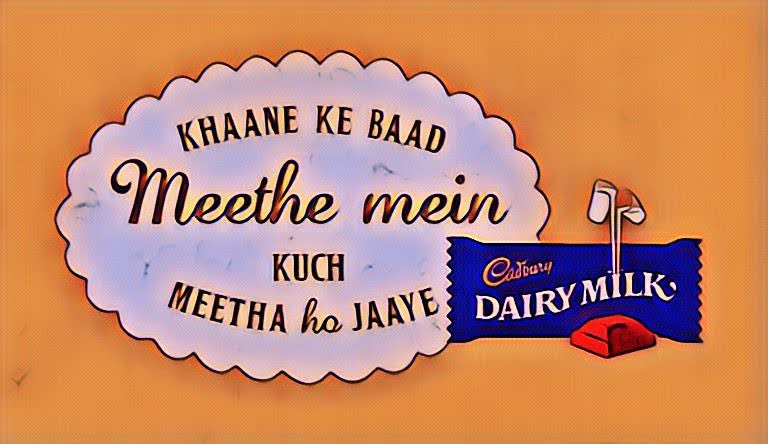
Fresh from the worm controversy of 2003 that dropped sales by 30%, Cadbury brings in Amitabh Bachchan — not as a product endorser, but as a cultural guardian. His presence doesn't say "this chocolate is good." It says "this chocolate is ours." The campaign positions Dairy Milk as the modern Indian meetha. The brand enters festive occasions it had never touched before — this is the decisive moment of the Cadbury brand India story.
2005–08 — "Pappu Pass Ho Gaya"
Targeting smaller cities and younger consumers. Every exam result is a Dairy Milk moment. Chocolate sales volume grows from 2% to 21.8% over four years. Business doubles in three years. Compounded annual sales growth of 22%. The brand is no longer borrowing from mithai occasions — it's creating new ones. This is the period that transforms Cadbury from a category participant into a category definer.
2018 — "Kuch Achha Ho Jaye" — The Generosity Campaign
Conceptualised by Ogilvy India for Cadbury's 70th year in India. An elder brother gives his younger brother his chocolate bar, pretending it was always there. The brand moves from "celebrate occasions" to "generate occasions through kindness." Sukesh Nayak, CCO Ogilvy India: "This story is a moment captured on a regular day between two brothers, told with a simple human charm, straight from the heart."
2021 — #GoodLuckGirls — "Real Taste of Life" Revisited
Ogilvy India recreates the 1994 cricket ad — with the genders reversed. Now a woman hits the winning shot, and the man runs onto the field dancing. The goosebumps were national and instantaneous. When the remake dropped, the brand didn't need to spend on paid amplification. The internet did it for free — because the campaign had built 27 years of emotional equity that made people feel like the original ad was theirs.
Piyush Pandey: "It needed a brave client in the '90s to go ahead with the original. It needed an even braver client to attempt making magic with an iconic film while reflecting the changing times."
03 — The Craft: Anatomy of the 1994 Cricket Brand Film
The 1994 "Real Taste of Life" cricket film is 90 seconds long. It has no celebrities, no CGI, and no performance marketing funnel attached to it. It is still the benchmark of Indian advertising three decades later. Here is why, frame by frame.
The Setting: A cricket match. Not a living room, not a kitchen. Cricket is the single largest shared emotional space in India. The target audience is, as Pandey put it, "every human being with an urge for a moment of joy."
The Protagonist: A young woman. Not a child (which would reinforce the "chocolate is for kids" problem). Not a man (which would make it a cricket ad). First-time model Shimona was cast precisely because she looked real — an early example of the authentic casting strategy that Indian brands are only now rediscovering through documentary-style content.
The Behaviour: Spontaneous, unself-conscious dance. Nobody performs for anyone. The joy is private and entirely her own — the emotional permission slip the entire campaign is built on. This is the moment that made it culturally transformative rather than commercially competent.
The Product Moment: The chocolate is in her hand before the joy begins. It isn't the reward. It isn't the cause. It is simply present — woven into the moment of joy rather than positioned as its source. This is the most sophisticated piece of product placement in the history of Indian advertising.
The Music: Piyush Pandey wrote the jingle on a boarding pass. It doesn't ask you to buy. It asks you to notice your life.
Brand Presence: Incidental. The chocolate bar appears the way a prop appears in a great film — necessary to the scene but never drawing attention to itself.
"I wanted to check if the doctor had done a good job." Then inspiration struck Pandey at a toy store in San Francisco filled with signs that said: 'By order of the management, you are obliged to play.' He wrote the jingle on the back of a boarding pass. The rest is Indian advertising history. — Piyush Pandey, Chairman & Creative Director, Ogilvy India
04 — The Results: What 30 Years of Correct Brand Storytelling Actually Delivers
22% — Compounded annual sales growth 2005–2008
2× — Business turnover doubled in three years (2005–2008)
30% — Cadbury's current share of India's branded chocolate market
₹3,000 crore+ — Cadbury India's annual revenue today
Today, the word "Cadbury" is the generic term for chocolate in large parts of India. A foreign brand, from Birmingham, that arrived in a country that didn't need its product, competing against a sweet tradition centuries older than the company itself — became the country's emotional shorthand for celebration. That didn't happen because of a media plan.
The Real Metric: Cultural ROI vs. Marketing ROI
When the 2021 "Real Taste of Life" remake dropped, the brand didn't need to spend on paid amplification. The internet did it for free. Because the campaign had built 27 years of emotional equity that made people feel like the original ad was theirs. That's not marketing ROI. That's cultural ROI — and it compounds in ways that performance dashboards will never capture.
This is the most important number in the entire Cadbury brand India story: the 2021 remake generated massive organic reach because of decisions made in 1994. Long-term brand storytelling is the only marketing investment that generates returns 27 years after the spend.
05 — Five Brand Strategy Lessons Your Brand Can Actually Use
Lesson 01 — Insert Into Culture. Don't Challenge It.
Cadbury didn't tell Indians that mithai was inferior. It said: you already love sweets for what they mean — and we are also a sweet that can mean the same thing. The cultural habit was respected. The brand was positioned as an additional option within it, not a replacement for it. This is cultural insertion marketing — the single most underused strategic tool in Indian brand building.
The application for your brand: find the emotional occasion your audience already has — the ritual, the habit, the shared moment — and position your product as something that belongs there. Don't ask people to change their behaviour. Ask them to include you in it.
Lesson 02 — The Emotion Must Precede the Brand
In the 1994 film, the joy arrives before the chocolate does. The audience falls in love with the feeling first. The brand arrives as the thing already present in the moment — not as the cause of it. This is the inversion that separates emotional brand storytelling from product advertising: you earn the association by being present in the feeling, not by claiming credit for it.
Lesson 03 — Hold the Emotional Territory. Let the Executions Evolve.
"Joy" has been Cadbury's emotional territory for 30 years. Cricket girl, Pappu Pass Ho Gaya, the generous brothers, the #GoodLuckGirls remake — different occasions, different demographics, different decades. But the same feeling. This is what long-term brand campaign strategy actually looks like: not a new positioning every three years, but a consistent emotional truth expressed through evolving cultural conversations.
Lesson 04 — Brave Clients Make Brave Ads. Cautious Clients Make Invisible Ones.
Piyush Pandey has said explicitly that the 1994 film required a brave client — one who decided not to research it beforehand. Every great piece of brand storytelling in Indian advertising history has a moment where someone had to choose between safety and truth. The brands that chose safety are not in this case study. The brands that chose truth are.
Lesson 05 — Your Comeback Story Is Also Content
In 2003, a worm controversy dropped Cadbury's sales by 30%. The brand's response — bringing in Amitabh Bachchan to stand for the brand's integrity — was itself a story. Consumer forgiveness is only available to brands that have earned love first. The crisis became content. The vulnerability became trust. This is only possible if the brand had been telling an honest story for years before the crisis arrived.
06 — The Takeaway: What Your Brand Can Build From Here
The 1994 cricket ad is approximately 90 seconds long. It features no celebrities, no CGI, no social media strategy, and no performance marketing funnel. It is still the benchmark of Indian advertising, three decades later.
Why? Because it said something true. It said: you are allowed to feel this much joy about something this small. Without apology, without product features, without a call to action.
Your brand has a version of that truth. It's sitting somewhere in the gap between what your product actually does and what it makes people feel when they use it. Finding that gap — and then having the courage to film it honestly — is the work. The reach will follow. It always does, for the brands willing to tell the truth.
"I believe the target audience for a chocolate or a laddoo is every human being with an urge for a moment of joy." — Piyush Pandey, Ogilvy India
What's the True Story Your Brand Has Been Sitting On? We help brands find the emotional truth at the centre of what they do — and build the story around it that lasts.
Start the Conversation →